
Artist Spotlight:Elif Hale Gokcen
Meet Elif Hale Gokcen, the Turkish calligrapher and illuminator who proves that the mind of a computer engineer and the soul of a classical artist are not so different after all.
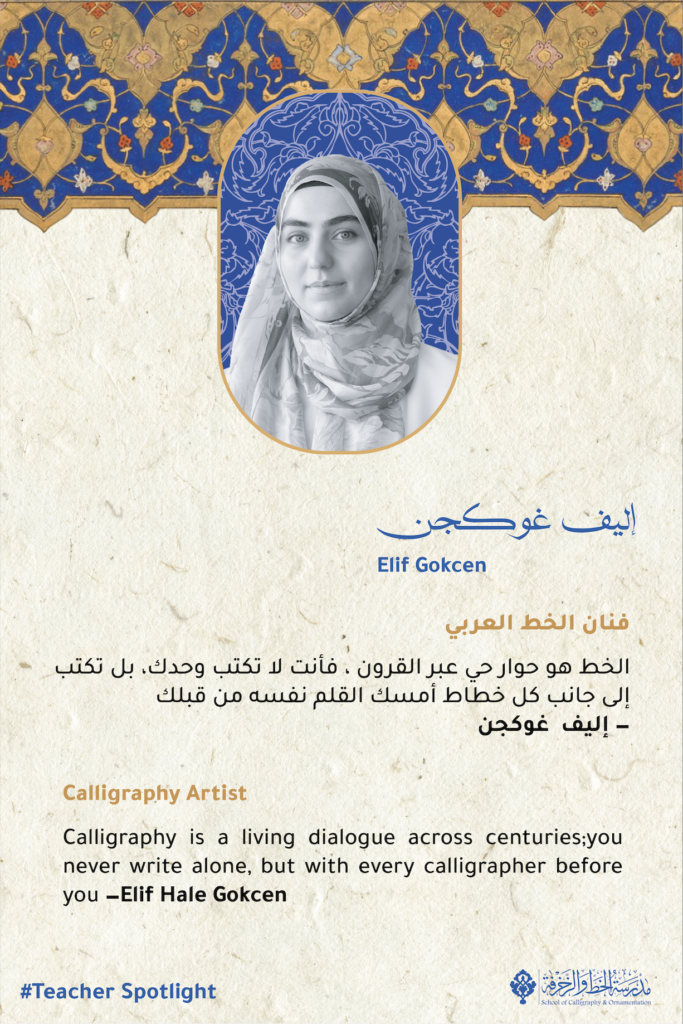
From Street Graffiti to the Meticulous Reed Pen
Before the delicate gold leaf and the meticulously cut reed pens (qalam), there were the bold, sweeping lines of spray paint. Growing up in Türkiye, Elif’s obsession with letterforms began long before any formal training. She was the kind of child who could lose whole afternoons chasing the perfect harmony between ink and paper. In middle school, this fascination found an outlet in the rebellious world of graffiti, a raw, modern encounter with the architecture of letters.
But everything shifted in high school when she walked into a classical Arabic calligraphy class.
“The moment I picked up the reed pen, something clicked,” she recalls with a sense of wonder. “I could practise for hours without ever getting tired. It didn’t feel like discipline; it felt like home.”
She quickly realized that in the traditional arts, a beautifully written word is rarely left unadorned. Calligraphy and tezhip (the classical art of illumination) are twin sisters. She threw herself into studying both, a dual mastery that still heavily influences her razor sharp eye for design today.
Writing with the Ghosts of Masters
Specializing in the elegant curves of Thuluth, Naskh, and Jali Thuluth, Elif is drawn to the sheer timelessness of these scripts. To watch her write is to watch time fold in on itself. For her, sitting at the easel is never a solitary act. It is an active, breathing engagement with an intellectual ecosystem that has survived and evolved over centuries.
“That evolution tells you something profound,” she explains. “You are never writing alone. You are writing alongside every calligrapher who has ever held the same pen.”
The Epiphany at Topkapı Palace
Every artist has a moment that fundamentally alters their trajectory. For Elif, that moment happened in the quiet, historic halls of Topkapı Palace in Istanbul.
Standing inches away from masterful, centuries old manuscripts, she was struck by the extraordinary intimacy of the pages. The flawless bindings, the geometric precision of the line arrangements, and the seamless dance between ink and illumination spoke to her. While many calligraphers today gravitate toward massive wall panels, Elif felt a powerful, undeniable pull toward the meticulous, fine line world of the traditional book arts.
To anchor herself in this discipline, she sought the mentorship of Ustadh Ahmed Fares Rezq. Under his guidance, the vast, intimidating depths of the craft opened up to her, giving her practice a newfound clarity and an uncompromising standard of excellence.
Where Algorithms Meet Ancient Ink
Perhaps the most fascinating layer of Elif’s story is what she brings to her easel: the highly trained, problem solving mind of a computer engineer. How does a brain wired for algorithms adapt to an art form older than the printing press? Flawlessly, it turns out.
In styles like Jali Thuluth, composing a single piece isn’t just drawing; it is solving a brilliant, intricate spatial puzzle. Her technical foundation gives her an incredible advantage in balancing these complex visual weights.
Furthermore, her training as an illuminator gives her a surgeon’s hand when it comes to tashih, the painstaking process of correcting the natural, microscopic deviations of the pen to achieve razor sharp, flawless letterforms. Because she speaks the visual language of traditional patterns fluently, her final pieces are cohesive masterpieces of design.
Passing the Key at SOCO
Today, Elif’s dedication has earned her formal recognition from the Ministry of Culture of Türkiye as a bearer of intangible cultural heritage. It is an honor that leaves her deeply humbled, yet fiercely motivated to keep the lineage alive.
In her workshops at SOCO, she doesn’t just teach the mechanics of writing; she hands her students a key. She challenges them to see traditional writing not as a mere hobby, but as a living symbol of human civilization. The evolution of our scripts mirrors the evolution of us. And by picking up the pen, her students aren’t just making art, they are actively participating in the beautiful, ongoing story of cultural continuation.